
Delhi's air quality was again in the severe category with the 24-hour average AQI recorded at 403 after remaining in the 'very poor' category till Tuesday morning, when the AQI was recorded at 396.

Delhi recorded an air quality index of 315 at 11:10 am. The last time the air quality hit such a poor level was in February.

Fuel pumps are not dispensing fuel to vehicles without valid PUC certificates, and this is being enforced with the help of automatic number plate reader cameras, voice alerts at pumps, and police support.

According to the Central Pollution Control Board (CPCB), the 24-hour average concentration of lung-damaging fine particles known as PM2.5 in Delhi-NCR shot up from 243 micrograms per cubic metre at 6 pm on Thursday (Diwali day) to 410 micrograms per cubic metre at 9 am on Friday, around seven times the safe limit of 60 micrograms per cubic metre.

In a gross violation of a Supreme Court order, people in several cities burst firecrackers until at least midnight, two hours after the 10 pm deadline. Loud bangs rent the air in New Delhi.

The India Meteorological Department (IMD) reports that ash clouds from volcanic activity in Ethiopia, which impacted flight operations in India, are drifting towards China and will move away from India by 7.30 pm on Tuesday.

It is believed that the crop residue burning in the nearby states of Punjab and Haryana are contributing to polluting the air.
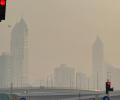
The Maharashtra Pollution Control Board (MPCB) has ordered the shutdown of 19 ready mix concrete plants in the Mumbai Metropolitan Region for violating environmental guidelines and contributing to deteriorating air quality levels.

The Bombay High Court criticized the Brihanmumbai Municipal Corporation (BMC) for its lack of action in addressing air pollution in Mumbai, questioning the approval of numerous large construction projects and urging preventive measures.

The Delhi High Court has asked the central government why it cannot reduce the GST on air purifiers, considering the poor air quality in Delhi. The court's concern is that the current 18% GST makes air purifiers unaffordable for the common man.

A city resident doesn't find Delhi to be livable anymore.
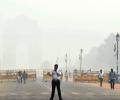
The overall AQI deteriorated further and touched the 268 mark, which falls in the poor category.

The clinics are expected to operate for at least two hours daily, particularly between September and March -- the period when air pollution levels are typically high.

The dramatic reversal in the situation caught people and weather scientists unaware.

Mundane as it may seem, this is in some ways a metaphor for the challenges facing the nation, argue Arvind Subramanian and Devesh Kapur in their new book, A Sixth Of Humanity.

Pollution levels in Delhi and satellite towns shot up again on Sunday morning, with the air quality bordering the 'severe plus' category at several places.

The national capital woke up on Tuesday morning to 'severe' air quality under a blanket of thick haze, as pollution levels breached the permissible standards by multiple times.

13 out of the world's 20 most polluted cities are in India. Most shockingly, the latest Central Pollution Control Board statistics reveal that the pollution levels in Gwalior, Raipur and even little known Kashipur are higher than that of Delhi which means we have some of the most polluted zones in the world.
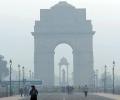
'Most pollution boards across the country have unused funds. There is practically no reason why pollution should not be a political priority.'

Noida, Bahadurgarh, Delhi, Hapur, Greater Noida, Baghpat, Sonipat, Meerut and Rohtak joined Ghaziabad among the 10 most polluted cities, the report by think tank Centre for Research on Energy and Clean Air said.

Dense winter fog and smog have gripped several Indian cities, from Agra's Taj Mahal to the streets of New Delhi, Srinagar, Lucknow, and beyond. These chilling visuals capture how residents, commuters, and tourists are coping with poor visibility and biting cold. From washermen on the Gomti riverbank to Shikara rides in Dal Lake, the photographs highlight the impact of extreme weather on daily life across northern India.
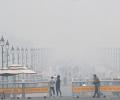
The SC questioned the Delhi government over delay in implementation of stricter anti-pollution measures under GRAP-4, and said it will not allow scaling down of the preventive measures without its prior permission.

The Supreme Court is considering relaxing the ban on firecrackers in Delhi-NCR ahead of Diwali, citing practical concerns and the need to balance environmental and livelihood interests.

Air quality in different parts of Mumbai dipped to nearly poor levels on Monday, December 30, 2024 prompting the civic authorities to call for strict pollution control measures, including the halting of construction activities.

The Supreme Court on Monday asked all the states to explain within six weeks as to why they should not be made liable to pay compensation to persons affected by bad air quality saying it is their bounden duty to provide basic civic amenities, clean air and drinking water to citizens.
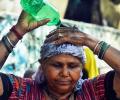
Temperatures are likely to remain in a similar range until Thursday, with a gradual fall expected from June 13.

A severe cold wave has intensified across North India, with Delhi recording its lowest temperature of the season. Rajasthan experienced sub-zero temperatures, and several states have issued alerts and closed schools due to the extreme conditions.

The Supreme Court has permitted the sale and bursting of green crackers in Delhi-NCR for Diwali, relaxing the ban on green firecrackers as a temporary measure from October 18 to 21. The court has asked pollution control boards to monitor pollution levels and file reports. The order also includes measures to prevent the sale of non-compliant crackers.
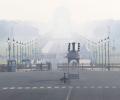
Toxic grey smog has sickened tens of thousands of people, mainly children and elderly people, since last month when the air quality started worsening in Lahore, the city bordering India.

The Supreme Court of India has directed the NHAI and MCD to consider relocating or temporarily closing toll plazas at Delhi's borders to alleviate traffic congestion and reduce air pollution. The court also addressed school closures and financial aid for construction workers affected by pollution control measures.

Some residents have already taken this step to relocate, either temporarily or permanently, some to their native places and others to clean-air destinations like Goa and Himachal Pradesh.
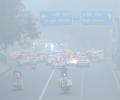
Curbs under Stage III include a ban on non-essential construction and demolition, closure of stone crushers and mining activities in Delhi-National Capital Region (NCR).
Experts warn that air pollution in India is a major public health crisis, leading to a surge in undiagnosed airway diseases and cardiovascular issues. They urge for urgent action, early detection, and treatment.

Delhi recorded its coldest January morning in three years with the minimum temperature dropping to 3 degrees Celsius. Cold wave conditions are expected to persist, and air quality has deteriorated to the 'very poor' category.

The fourth T20I between India and South Africa was called off on Wednesday owing to poor visibility after a dense layer of smog engulfed the Ekana Stadium raising serious questions about BCCI's scheduling of matches in northern part of India during peak winter month.

Air quality index (AQI) soared past 350 level in parts of Delhi on Thursday and experts cautioned that as weather turns colder it may breach the 400-mark ceiling and enter the 'severe' zone soon, notwithstanding the incidents of stubble burnings which have nosedived from 17,529 in 2020 to 4,262 this year.

Tourists at the Taj Mahal found themselves taking selfies with the iconic monument barely visible in the fog.

In view of air pollution in the national capital, the December winter break of all schools has been rescheduled and it will be now from November 9 to November 18, a circular of the Delhi Directorate of Education stated on Wednesday.

Delhi's air quality improved for the second consecutive day on Thursday, with the Air Quality Index (AQI) recorded in the "moderate" category at 165. This marks a significant improvement from the "poor" category recorded on Tuesday. Several restrictions imposed under Stage 4 of the Graded Response Action Plan (GRAP) were lifted, but some restrictions under Stage 2 remain in place. The Decision Support System (DSS) has not been updated since Friday, with technical difficulties hindering the update of data for the last six days.

'The real story of 2025 is that India officially stopped being a 'market of the future' and started acting as the world's primary economic engine.'
